top of page
No Collections Here
Sort your projects into collections. Click on "Manage Collections" to get started
經文系列
以《心經》《金剛經》及《易經》為核心,運用獨創的「雨水皴」技法,將經文隱入畫面之中,隨光影變化而若隱若現。這些符號不只是文字,而是一種能量的場域,象徵陰陽交融、乾坤互動,提醒人們從無常中窺見智慧。作品讓觀者在凝視中,從有限的形象觸及無限的宇宙奧義。


2021《道 NO.1》
在《道 NO.1》中,沈昌明以獨創技法「雨水皴」灑落點狀與線狀粒子,透過「平撒」與「直撒」的筆法,構築出顆粒與流動交錯的視覺場。這些粒子象徵量子顆粒的存在與變動,成為宇宙訊息場的顯現。同時,「雨水皴」技法也展現出一種心念與宇宙萬物之間的對話。
畫作呼應從「太極」拓展至「無限」的宇宙生成。藍與紅的弧形能量場環繞著中央圓體,象徵陰陽合一、乾坤交融,是那不斷旋轉、持續變化的宇宙動力。《心經》經文則以陰刻方式隱伏其中,隨著光影流動若隱若現,給人帶來一種視覺與心識的雙重觸動。
《道 NO.1》, 2021
畫作呼應從「太極」拓展至「無限」的宇宙生成。藍與紅的弧形能量場環繞著中央圓體,象徵陰陽合一、乾坤交融,是那不斷旋轉、持續變化的宇宙動力。《心經》經文則以陰刻方式隱伏其中,隨著光影流動若隱若現,給人帶來一種視覺與心識的雙重觸動。
《道 NO.1》, 2021


2021《道 NO.2》
《道 NO.2》彷彿一座能量密碼場,映照人間百態與世間萬象:三顆圓體垂直排列,象徵著天地人三才,而左右對稱的色帶如宇宙間不斷律動的能量波,構成一幅持續遞進、循環運行的宇宙爻象。老莊智慧中「一生二、二生三、三生萬物」的思想延展至八卦、六十四卦、三百八十四爻,正是映照出人間百態與世間萬象。
畫面底層則以《心經》全文陰刻而成,將經文隱入畫作之中,是一種不可見的智慧場域,象徵人在其中,於天地、時間與人際交錯的動態中,不斷學習觀察、回應與平衡之道。這亦是《心經》中「諸法空相」、「色不異空、空不異色」的實踐智慧。當光影掠過畫面,經文將於光線折射之間隱現而出,如同人的心識清明之時的那一刻,瞥見了萬事萬物背後所蘊含的智慧之光。
《道 NO.2》, 2021
畫面底層則以《心經》全文陰刻而成,將經文隱入畫作之中,是一種不可見的智慧場域,象徵人在其中,於天地、時間與人際交錯的動態中,不斷學習觀察、回應與平衡之道。這亦是《心經》中「諸法空相」、「色不異空、空不異色」的實踐智慧。當光影掠過畫面,經文將於光線折射之間隱現而出,如同人的心識清明之時的那一刻,瞥見了萬事萬物背後所蘊含的智慧之光。
《道 NO.2》, 2021


2021《金剛經四句偈》
「一切有為法,如夢幻泡影,如露亦如電,應作如是觀」。經文隱入作品底層,隨「雨水皴」的點狀粒子層層疊加,逐漸浮現出山的輪廓。既是山、也似雲,其間的紅日、金色光影與漂浮的白雲,也蘊含著人生對事物認識的逐步深入和昇華,從簡單到複雜,再回歸純粹的過程。體現出人生中「看山是山,看山不是山,看山又是山」的心境。
《金剛經四句偈》, 2021
《金剛經四句偈》, 2021


2023《金剛經四句偈》
浪花象徵著澎湃的心境,來去自如,不受拘束;岩石則象徵了本心,無論浪花如何變化萬千,依然如如不動。畫面上方的三顆太陽,從東升、日正當午到西沉,呈現日軌的循環與時間的推進;也象徵了過去、現在與未來共存於同一個當下。而當下即是力量——若今日的自己已然蛻變,過去的詮釋與未來的走向,也已悄然轉移至另一個平行宇宙。
畫作底藏經文「應無所住而生其心」,以「雨水皴」技法一層層疊加,隱喻在動與不動、變與不變間,破除許多觀念,也體悟各種觀念的存在,也是在幫助不同的人變得更健康、更覺醒,因而不執著,活得自在。
《金剛經四句偈》, 2023
畫作底藏經文「應無所住而生其心」,以「雨水皴」技法一層層疊加,隱喻在動與不動、變與不變間,破除許多觀念,也體悟各種觀念的存在,也是在幫助不同的人變得更健康、更覺醒,因而不執著,活得自在。
《金剛經四句偈》, 2023


2023《天行健》
《易經》中的「乾卦」象徵陽的發動力量,「坤卦」則如同母親般包容萬象 —— 陰陽交融,方能化生萬物。
三顆橙紅色圓體橫列於天際,既是日軌的痕跡,也像自轉中的太陽與月亮,呈現時間的推進與光影的律動。
經文「一切有為法,如夢幻泡影,如露亦如電,應作如是觀」隱伏於色層之下,唯有在特定光線下才會顯現而出,提醒著世間一切現象皆為轉瞬流轉的存在,暗喻著生命智慧需於巧妙微妙之角度方能一窺。
《天行健》, 2023
三顆橙紅色圓體橫列於天際,既是日軌的痕跡,也像自轉中的太陽與月亮,呈現時間的推進與光影的律動。
經文「一切有為法,如夢幻泡影,如露亦如電,應作如是觀」隱伏於色層之下,唯有在特定光線下才會顯現而出,提醒著世間一切現象皆為轉瞬流轉的存在,暗喻著生命智慧需於巧妙微妙之角度方能一窺。
《天行健》, 2023


2023《心無罣礙》
流動白色線條穿梭於色彩層次之間,如能量的脈動,展現出宇宙的神秘律動。畫面由三個大小不一的圓體垂直排列,寓意多重:既象徵「天、地、人」三才,也彷彿展現出太陽、地球與月亮的緊密聯繫,更隱喻了「一生二、二生三、三生萬物」,萬物皆相連的真理。
作品底層以小篆體隱伏「心無罣礙」四字,於光影間若隱若現。紅色圓體則在透視中拉開距離,既深邃又浩瀚,彷彿是遠達億萬光年的宇宙,也宛如人們靜觀內心時,直至心靈深處浮現的一道明晰之光。
《心無罣礙》, 2023
作品底層以小篆體隱伏「心無罣礙」四字,於光影間若隱若現。紅色圓體則在透視中拉開距離,既深邃又浩瀚,彷彿是遠達億萬光年的宇宙,也宛如人們靜觀內心時,直至心靈深處浮現的一道明晰之光。
《心無罣礙》, 2023


2025《色空》
《色空》取意自《心經》核心思想「色即是空,空即是色」,融入佛教「地、水、火、風」四大「四空」元素。整幅作品以三十餘層顏色的噴灑與堆疊構成,畫面深處隱刻完整之《心經》經文,文字潛藏於色彩與層次之間,隨光影而顯現,如同「色」與「空」的交互流轉。
繪製此作,如同一次又一次地深刻冥想,隨著筆觸與顏色的自然流動。每一次噴灑的力道、角度與位置,皆隨境而成,映現佛法所說得「隨緣」與「自在」。畫面氛圍如大地之母的承載,也似是生命之樹的向上延展,蘊含著「光亮」在虛空中閃爍顯現的畫面。
《色空》展現了物質與虛空、顯與隱、生與滅的交融,彷彿將經文的靜謐、天地間的脈動,以及色彩光線的美麗同時保存了下來。
《色空》, 2025
繪製此作,如同一次又一次地深刻冥想,隨著筆觸與顏色的自然流動。每一次噴灑的力道、角度與位置,皆隨境而成,映現佛法所說得「隨緣」與「自在」。畫面氛圍如大地之母的承載,也似是生命之樹的向上延展,蘊含著「光亮」在虛空中閃爍顯現的畫面。
《色空》展現了物質與虛空、顯與隱、生與滅的交融,彷彿將經文的靜謐、天地間的脈動,以及色彩光線的美麗同時保存了下來。
《色空》, 2025


2025《上善若水》
「上善若水」取意自《道德經》第八章。水雖柔順,卻能穿石成洞;隨器而形,卻始終保持流動的本性。它的德性在於「利萬物而不爭」,滋養一切,卻不居功。
畫面粗獷中透出細膩,乍看如瀑布奔流,細觀則似涓涓細流,與大自然的肌理交織。水自山間傾瀉,化為川流,再蒸騰成雲霧,最終歸於大海,象徵天地間的循環往復與相互奉獻。
水的流動也喻示了萬物的一體性。每一滴水皆是大海,每一片雲霧亦是大海,奔騰於山間的溪流,也是大海。此作讓觀眾在水的流轉間,感受生命的柔韌與力量,也點出水無聲的智慧。
《上善若水》, 2025
畫面粗獷中透出細膩,乍看如瀑布奔流,細觀則似涓涓細流,與大自然的肌理交織。水自山間傾瀉,化為川流,再蒸騰成雲霧,最終歸於大海,象徵天地間的循環往復與相互奉獻。
水的流動也喻示了萬物的一體性。每一滴水皆是大海,每一片雲霧亦是大海,奔騰於山間的溪流,也是大海。此作讓觀眾在水的流轉間,感受生命的柔韌與力量,也點出水無聲的智慧。
《上善若水》, 2025


2025《敬天愛人》
《敬天愛人》三顆圓體由上而下的排列,呈現出清晰的垂直軸線。最上方的太陽以紅與金黃釋放強勁光熱,象徵對天地的敬畏與「敬天愛人」的心念,同時指向萬物滋長的源頭。
下方以綠、紫、藍的細點層層鋪陳,交織出大地與海洋的肌理。光與色的交錯,生命在太陽的照耀下勃發,展現出向上躍動的蓬勃生命力。即便倒置觀看,天地結構依舊穩定,表現出天地間所達成的均衡。
在熾烈與柔和、宏觀與微觀、個體與群體、以及給予與承接間,彼此調頻、相生相成,動態平衡。
底層撰寫「敬天愛人」—— 寓意在無常之中維持和諧,以關懷與行動促成共生,使萬物得滋長並相互成全。
《敬天愛人》, 2025
下方以綠、紫、藍的細點層層鋪陳,交織出大地與海洋的肌理。光與色的交錯,生命在太陽的照耀下勃發,展現出向上躍動的蓬勃生命力。即便倒置觀看,天地結構依舊穩定,表現出天地間所達成的均衡。
在熾烈與柔和、宏觀與微觀、個體與群體、以及給予與承接間,彼此調頻、相生相成,動態平衡。
底層撰寫「敬天愛人」—— 寓意在無常之中維持和諧,以關懷與行動促成共生,使萬物得滋長並相互成全。
《敬天愛人》, 2025


2025《獨行》
《獨行》體現了量子力學與禪宗哲思的交會,融合了「疊加態」與「應無所住而生其心」的智慧。以細沙為媒材,象徵宇宙最基本的能量單位—「粒子」,同時也是《金剛經》中「微塵眾」的現代詮釋。
畫面由兩層結構組成:底層以浮雕手法刻寫《金剛經》四句偈「應無所住而生其心」,這些文字潛藏於畫布之內,平時難以察覺;表層則描繪了一位身披紅衣的僧人獨自行走,背景彷彿宇宙洪荒,散落的粒了營造出漂浮的氛圍。
當觀者移動視角,底層的經文會隨光線與角度變化若隱若現,如同量子疊加態中未被觀測時的不確定性—當你凝視僧人時,經文或許隱藏;當你轉換角度,文字才緩緩浮現。這種動態觀賞體驗,映射了佛學與量子物理的共同命題—「觀測改變實相」,及「無住」的覺性。
《獨行》不只是靜態的畫作,而是一場關於觀察者與被觀察者的對話,一場在科學與禪意之間流動的沉思。
Lone Walker embodies the intersection of quantum mechanics and Zen philosophy, merging the concept of "superposition" with the wisdom of "arising a mind that does not abide in anything." Utilizing fine sand as a medium, the work symbolizes the fundamental energy units of the universe—the "particles"—serving as a modern interpretation of the "multitudes of dust motes" described in the Diamond Sutra.
The composition is structured in two layers: the base layer features the four-line verse from the Diamond Sutra—"Arise a mind that does not abide in anything"—rendered in intaglio-relief. These characters are embedded within the canvas, remaining subtle and elusive to the casual observer. The surface layer depicts a solitary monk cloaked in crimson, walking through a primordial cosmic expanse, where scattered particles create an ethereal sense of suspension.
As the viewer shifts their perspective, the scriptures beneath flicker in and out of sight, mirroring the uncertainty of the quantum superposition state before observation. When you focus on the monk, the text may recede; when you change your angle, the characters slowly emerge. This dynamic viewing experience maps onto the shared proposition of Buddhism and quantum physics: that "observation alters reality," and reflects the enlightened state of "non-abiding."
Lone Walker is more than a static painting; it is a dialogue between the observer and the observed, a meditation flowing between the realms of science and Zen.
畫面由兩層結構組成:底層以浮雕手法刻寫《金剛經》四句偈「應無所住而生其心」,這些文字潛藏於畫布之內,平時難以察覺;表層則描繪了一位身披紅衣的僧人獨自行走,背景彷彿宇宙洪荒,散落的粒了營造出漂浮的氛圍。
當觀者移動視角,底層的經文會隨光線與角度變化若隱若現,如同量子疊加態中未被觀測時的不確定性—當你凝視僧人時,經文或許隱藏;當你轉換角度,文字才緩緩浮現。這種動態觀賞體驗,映射了佛學與量子物理的共同命題—「觀測改變實相」,及「無住」的覺性。
《獨行》不只是靜態的畫作,而是一場關於觀察者與被觀察者的對話,一場在科學與禪意之間流動的沉思。
Lone Walker embodies the intersection of quantum mechanics and Zen philosophy, merging the concept of "superposition" with the wisdom of "arising a mind that does not abide in anything." Utilizing fine sand as a medium, the work symbolizes the fundamental energy units of the universe—the "particles"—serving as a modern interpretation of the "multitudes of dust motes" described in the Diamond Sutra.
The composition is structured in two layers: the base layer features the four-line verse from the Diamond Sutra—"Arise a mind that does not abide in anything"—rendered in intaglio-relief. These characters are embedded within the canvas, remaining subtle and elusive to the casual observer. The surface layer depicts a solitary monk cloaked in crimson, walking through a primordial cosmic expanse, where scattered particles create an ethereal sense of suspension.
As the viewer shifts their perspective, the scriptures beneath flicker in and out of sight, mirroring the uncertainty of the quantum superposition state before observation. When you focus on the monk, the text may recede; when you change your angle, the characters slowly emerge. This dynamic viewing experience maps onto the shared proposition of Buddhism and quantum physics: that "observation alters reality," and reflects the enlightened state of "non-abiding."
Lone Walker is more than a static painting; it is a dialogue between the observer and the observed, a meditation flowing between the realms of science and Zen.


2025《心經 · 自在觀音》
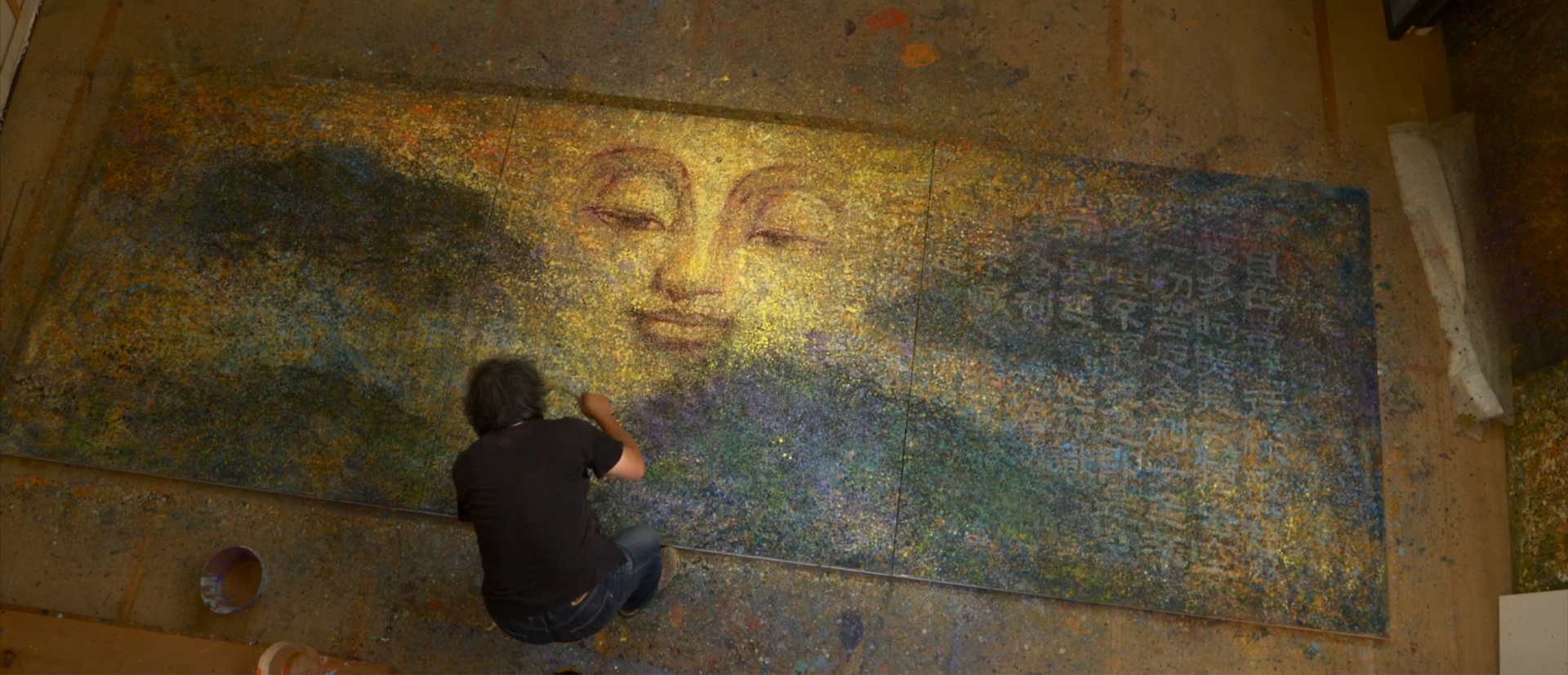
畫面中的佛像以深粉紅的色調構築,傳遞出溫暖而超脫的氛圍,而260字的《心經》經文覆蓋於畫布之上,形成一種視覺與哲理的共振。畫作整體以細膩的砂粒和重疊的筆觸呈現出微塵般的視覺效果,象徵萬物因緣和合而成、因緣盡而滅的循環之道。
The Buddha in this composition is rendered in deep shades of pink, radiating a warmth that transcends the mundane. The full 260 characters of The Heart Sutra are layered across the canvas, creating a profound resonance between visual form and philosophical truth. Through the meticulous application of fine sand and overlapping brushstrokes, the work achieves a visual texture reminiscent of "dust motes," symbolizing the cycle of existence—where all things arise from the coming together of causes and conditions, and vanish when those conditions disperse.
The Buddha in this composition is rendered in deep shades of pink, radiating a warmth that transcends the mundane. The full 260 characters of The Heart Sutra are layered across the canvas, creating a profound resonance between visual form and philosophical truth. Through the meticulous application of fine sand and overlapping brushstrokes, the work achieves a visual texture reminiscent of "dust motes," symbolizing the cycle of existence—where all things arise from the coming together of causes and conditions, and vanish when those conditions disperse.


2026《心經 · 量子佛境》
這件作品,是沈昌明「量子當代藝術」中極具代表性的創作形式:以《心經》文字作為底層結構,再疊加佛像繪畫於其上,形成如量子疊加般的視覺狀態。觀者在不同距離與光線之下,會同時感受到文字與佛像彼此穿透、融合、顯現與隱沒。作品因此
不只是「看見佛」,更是一種觀看「空性」的過程。
底層的《心經》全文,以密集而重複的方式鋪陳於畫面之中,宛如宇宙中的基本粒子。藝術家以砂粒、飛灑顏料與陰刻般的文字肌理,使經文不再
只是可閱讀的語言,而成為能量振動的痕跡。當觀者靠近時,可以辨識出「色即是空,空即是色」等經句;退遠觀看時,文字又逐漸消融,重新聚合成佛陀莊嚴靜定的形象。
這種由局部到整體、由文字到形象的轉化,正呼應量子力學中的「波粒二象性」—微觀時是粒子,宏觀時又成為波動與整體。藝術家將佛經中的「緣起性空」與量子世界的不確定性互相對照,讓畫面呈現出一種既存在又虛空、既凝聚又流動的狀態。
畫面中央的佛像沉靜端坐,如宇宙中心不動的覺性。金黃色的佛光,從頭部向四周擴散,像能量場一般與背景文字相互滲透。佛像本身並非厚重實體,而是由無數細小色點與微塵構成,彷彿提醒著觀者:所謂形體,其實也是短暫聚合的能量顯現。
作品下方加入蓮花與玄奘西行的意象,更深化了《心經》的精神內涵。蓮花象徵清淨覺悟;玄奘則代表人類對真理與智慧的追尋。他行走於塵世,而佛安住於空性之中,形成「修行」與「覺悟」、「行」與「定」之間的深層對話。
沈昌明長期將佛學、量子力學與當代藝術融合。他認為,《心經》所說的「空」並非虚無,而是一切萬物彼此關聯、流動生成的狀態;而量子世界中的疊加、糾纏與能量振動,也正提供了另一種理解宇宙的方式。因此,這件作品並不只是宗教圖像,而
是一種關於生命本質的視覺哲學。
當觀者凝視畫面時,其實也正在進入自己的內心。那些漂浮的微塵、若隱若現的經文,以及佛像靜默的神情,共同形成一個介於現實與虚空之間的精神場域,使人在觀看之中,重新體會《心經》所說:「照見五蘊皆空,度一切苦厄。」
This work serves as a quintessential example of Shen Chang-ming’s "Quantum Contemporary Art." By utilizing the full text of The Heart Sutra as a structural foundation and layering a portrait of the Buddha upon it, the artist constructs a visual state analogous to quantum superposition. From varying distances and angles of light, the viewer perceives the scriptures and the Buddha image as phenomena that interpenetrate, merge, emerge, and dissolve. Thus, the work is not merely an act of "seeing the Buddha," but a process of witnessing "Emptiness" itself.
The base layer of the full Heart Sutra is densely and repetitively inscribed across the canvas, functioning like the fundamental particles of the universe. Through the use of sand, splattered pigments, and intaglio-like textural depth, the scriptures are transformed from readable language into traces of energetic vibration. Up close, one can decipher phrases such as "Form is emptiness, emptiness is form"; yet, from a distance, these characters dissolve and coalesce into the serene, majestic visage of the Buddha.
This transformation from the local to the holistic—from text to image—mirrors the "wave-particle duality" in quantum mechanics: microscopic particles manifesting as macroscopic waves. The artist juxtaposes the Buddhist concept of "dependent origination and the nature of emptiness" with the inherent uncertainty of the quantum world, resulting in a composition that is simultaneously existent and void, condensed and fluid.
At the center of the canvas, the Buddha sits in stillness, representing the immutable awareness at the heart of the cosmos. Golden light radiates from the Buddha’s form, permeating the background text like a living energy field. The Buddha is not portrayed as a dense, static entity, but as a construct of countless tiny colored dots and motes of dust—a poignant reminder that form is merely a temporary aggregation of energy.
The inclusion of lotus flowers and imagery of Xuanzang’s pilgrimage at the bottom deepens the spiritual resonance of The Heart Sutra. The lotus symbolizes pure enlightenment, while Xuanzang embodies the human quest for truth and wisdom. As Xuanzang traverses the earthly realm while the Buddha dwells in Emptiness, the composition fosters a profound dialogue between "practice" and "enlightenment," between "action" and "stillness."
Shen Chang-ming has long dedicated his practice to synthesizing Buddhism, quantum mechanics, and contemporary art. He posits that the "Emptiness" defined in The Heart Sutra is not nihility, but a state of dynamic flow and interdependent generation. Similarly, the concepts of superposition, entanglement, and energetic vibration in the quantum world provide a new lens through which to understand the universe. Consequently, this work transcends the boundaries of religious iconography, emerging as a visual philosophy regarding the essence of life.
As one gazes into the canvas, one is effectively looking inward. The floating dust, the flickering scriptures, and the silent expression of the Buddha coalesce into a spiritual field suspended between reality and void—inviting the viewer to rediscover the clarity of the Sutra’s promise: "Illuminated the five aggregates as empty, and transcended all suffering.
不只是「看見佛」,更是一種觀看「空性」的過程。
底層的《心經》全文,以密集而重複的方式鋪陳於畫面之中,宛如宇宙中的基本粒子。藝術家以砂粒、飛灑顏料與陰刻般的文字肌理,使經文不再
只是可閱讀的語言,而成為能量振動的痕跡。當觀者靠近時,可以辨識出「色即是空,空即是色」等經句;退遠觀看時,文字又逐漸消融,重新聚合成佛陀莊嚴靜定的形象。
這種由局部到整體、由文字到形象的轉化,正呼應量子力學中的「波粒二象性」—微觀時是粒子,宏觀時又成為波動與整體。藝術家將佛經中的「緣起性空」與量子世界的不確定性互相對照,讓畫面呈現出一種既存在又虛空、既凝聚又流動的狀態。
畫面中央的佛像沉靜端坐,如宇宙中心不動的覺性。金黃色的佛光,從頭部向四周擴散,像能量場一般與背景文字相互滲透。佛像本身並非厚重實體,而是由無數細小色點與微塵構成,彷彿提醒著觀者:所謂形體,其實也是短暫聚合的能量顯現。
作品下方加入蓮花與玄奘西行的意象,更深化了《心經》的精神內涵。蓮花象徵清淨覺悟;玄奘則代表人類對真理與智慧的追尋。他行走於塵世,而佛安住於空性之中,形成「修行」與「覺悟」、「行」與「定」之間的深層對話。
沈昌明長期將佛學、量子力學與當代藝術融合。他認為,《心經》所說的「空」並非虚無,而是一切萬物彼此關聯、流動生成的狀態;而量子世界中的疊加、糾纏與能量振動,也正提供了另一種理解宇宙的方式。因此,這件作品並不只是宗教圖像,而
是一種關於生命本質的視覺哲學。
當觀者凝視畫面時,其實也正在進入自己的內心。那些漂浮的微塵、若隱若現的經文,以及佛像靜默的神情,共同形成一個介於現實與虚空之間的精神場域,使人在觀看之中,重新體會《心經》所說:「照見五蘊皆空,度一切苦厄。」
This work serves as a quintessential example of Shen Chang-ming’s "Quantum Contemporary Art." By utilizing the full text of The Heart Sutra as a structural foundation and layering a portrait of the Buddha upon it, the artist constructs a visual state analogous to quantum superposition. From varying distances and angles of light, the viewer perceives the scriptures and the Buddha image as phenomena that interpenetrate, merge, emerge, and dissolve. Thus, the work is not merely an act of "seeing the Buddha," but a process of witnessing "Emptiness" itself.
The base layer of the full Heart Sutra is densely and repetitively inscribed across the canvas, functioning like the fundamental particles of the universe. Through the use of sand, splattered pigments, and intaglio-like textural depth, the scriptures are transformed from readable language into traces of energetic vibration. Up close, one can decipher phrases such as "Form is emptiness, emptiness is form"; yet, from a distance, these characters dissolve and coalesce into the serene, majestic visage of the Buddha.
This transformation from the local to the holistic—from text to image—mirrors the "wave-particle duality" in quantum mechanics: microscopic particles manifesting as macroscopic waves. The artist juxtaposes the Buddhist concept of "dependent origination and the nature of emptiness" with the inherent uncertainty of the quantum world, resulting in a composition that is simultaneously existent and void, condensed and fluid.
At the center of the canvas, the Buddha sits in stillness, representing the immutable awareness at the heart of the cosmos. Golden light radiates from the Buddha’s form, permeating the background text like a living energy field. The Buddha is not portrayed as a dense, static entity, but as a construct of countless tiny colored dots and motes of dust—a poignant reminder that form is merely a temporary aggregation of energy.
The inclusion of lotus flowers and imagery of Xuanzang’s pilgrimage at the bottom deepens the spiritual resonance of The Heart Sutra. The lotus symbolizes pure enlightenment, while Xuanzang embodies the human quest for truth and wisdom. As Xuanzang traverses the earthly realm while the Buddha dwells in Emptiness, the composition fosters a profound dialogue between "practice" and "enlightenment," between "action" and "stillness."
Shen Chang-ming has long dedicated his practice to synthesizing Buddhism, quantum mechanics, and contemporary art. He posits that the "Emptiness" defined in The Heart Sutra is not nihility, but a state of dynamic flow and interdependent generation. Similarly, the concepts of superposition, entanglement, and energetic vibration in the quantum world provide a new lens through which to understand the universe. Consequently, this work transcends the boundaries of religious iconography, emerging as a visual philosophy regarding the essence of life.
As one gazes into the canvas, one is effectively looking inward. The floating dust, the flickering scriptures, and the silent expression of the Buddha coalesce into a spiritual field suspended between reality and void—inviting the viewer to rediscover the clarity of the Sutra’s promise: "Illuminated the five aggregates as empty, and transcended all suffering.


2026《緣起性空 · 心經》
Dependent Origination and Emptiness,2026,227 x 162 cm


2026《上善若水 · 厚德載物》
作品以砂粒為底,在畫布深層塑造「上善若水、厚德載物」八字,形成若隱若現的凹凸肌理;表層則以遠山、瀑布與溪流層層疊加,使文字與山水彼此交融,形成一種既可見、又不可盡見的視覺狀態。
「上善若水」出自《道德經》。水滋養萬物而不爭,總是往低處流,卻能穿石、成川、匯聚江海。它看似柔弱,實則蘊藏最持久的力量。「厚德載物」則源自《易經》坤卦:「地勢坤,君子以厚德載物。」大地沉默而寬厚,承載萬物,不分彼此。
畫面中的高山如「德」,沉穩厚實;瀑布與溪水如「善」,順勢而行。水從高處落下,穿越山石,最終匯聚於低處,正如人生——真正的力量不一定來自爭勝,而可能來自謙卑、包容與持續前行。
砂粒象徵大地,也如宇宙中的微塵;文字藏於砂粒之中,山水又覆於文字之上。經典、自然與繪畫彼此疊加,讓「上善若水」與「厚德載物」不只是文字,而成為可以觀看、感受與體悟的生命風景。
水因不爭而無所不至,地因厚德而無所不載。
願人在山水之間,也能找到一份柔軟而堅定、謙遜而寬廣的生命力量。
With sand as its foundational substrate, the artwork molds eight Chinese characters—*“Shang Shan Ruo Shui, Hou De Zai Wu”* (Highest Virtue is Like Water; Great Virtue Carries All Things)—into the deep layers of the canvas, creating a subtle, low-relief texture that hovers between visibility and illusion. The surface layers are built through shifting gradations of distant mountains, cascading waterfalls, and flowing streams, allowing text and landscape to intertwine into a visual state that is simultaneously present yet never fully revealed.
“Highest virtue is like water” originates from the *Daodejing*. Water nourishes all things without striving; it constantly flows toward the lowest places, yet possesses the power to carve through stone, forge rivers, and gather into boundless seas. Seemingly soft and fragile, it holds the most enduring strength. “Great virtue carries all things” stems from the *Kun* (Earth) hexagram of the *I Ching*: “The earth's capacity is vast and receptive; thus the noble person, through ample virtue, sustains all existence.” The earth remains silent and broad-minded, bearing all things without distinction.
In this composition, the lofty mountains embody “Virtue”—steadfast and profound—while the waterfalls and streams represent “Goodness”—moving in harmony with natural momentum. As water descends from the heights, navigating through mountain rocks to gather in the valleys below, it mirrors the human journey: true strength does not necessarily arise from contention, but from humility, tolerance, and quiet perseverance.
Grains of sand symbolize the earth as well as the microscopic dust of the universe. Ancient text is embedded within the sand, while natural scenery is layered above the text. Classics, nature, and the painterly medium stack upon one another, transforming these timeless concepts from mere words into a living landscape to be observed, felt, and pondered.
*Water reaches everywhere because it does not compete; the Earth sustains everything through its infinite breadth of virtue.*
May we, standing amidst these mountains and waters, discover our own sense of resilient grace, humble wisdom, and expansive inner peace.
「上善若水」出自《道德經》。水滋養萬物而不爭,總是往低處流,卻能穿石、成川、匯聚江海。它看似柔弱,實則蘊藏最持久的力量。「厚德載物」則源自《易經》坤卦:「地勢坤,君子以厚德載物。」大地沉默而寬厚,承載萬物,不分彼此。
畫面中的高山如「德」,沉穩厚實;瀑布與溪水如「善」,順勢而行。水從高處落下,穿越山石,最終匯聚於低處,正如人生——真正的力量不一定來自爭勝,而可能來自謙卑、包容與持續前行。
砂粒象徵大地,也如宇宙中的微塵;文字藏於砂粒之中,山水又覆於文字之上。經典、自然與繪畫彼此疊加,讓「上善若水」與「厚德載物」不只是文字,而成為可以觀看、感受與體悟的生命風景。
水因不爭而無所不至,地因厚德而無所不載。
願人在山水之間,也能找到一份柔軟而堅定、謙遜而寬廣的生命力量。
With sand as its foundational substrate, the artwork molds eight Chinese characters—*“Shang Shan Ruo Shui, Hou De Zai Wu”* (Highest Virtue is Like Water; Great Virtue Carries All Things)—into the deep layers of the canvas, creating a subtle, low-relief texture that hovers between visibility and illusion. The surface layers are built through shifting gradations of distant mountains, cascading waterfalls, and flowing streams, allowing text and landscape to intertwine into a visual state that is simultaneously present yet never fully revealed.
“Highest virtue is like water” originates from the *Daodejing*. Water nourishes all things without striving; it constantly flows toward the lowest places, yet possesses the power to carve through stone, forge rivers, and gather into boundless seas. Seemingly soft and fragile, it holds the most enduring strength. “Great virtue carries all things” stems from the *Kun* (Earth) hexagram of the *I Ching*: “The earth's capacity is vast and receptive; thus the noble person, through ample virtue, sustains all existence.” The earth remains silent and broad-minded, bearing all things without distinction.
In this composition, the lofty mountains embody “Virtue”—steadfast and profound—while the waterfalls and streams represent “Goodness”—moving in harmony with natural momentum. As water descends from the heights, navigating through mountain rocks to gather in the valleys below, it mirrors the human journey: true strength does not necessarily arise from contention, but from humility, tolerance, and quiet perseverance.
Grains of sand symbolize the earth as well as the microscopic dust of the universe. Ancient text is embedded within the sand, while natural scenery is layered above the text. Classics, nature, and the painterly medium stack upon one another, transforming these timeless concepts from mere words into a living landscape to be observed, felt, and pondered.
*Water reaches everywhere because it does not compete; the Earth sustains everything through its infinite breadth of virtue.*
May we, standing amidst these mountains and waters, discover our own sense of resilient grace, humble wisdom, and expansive inner peace.
bottom of page