Create Your First Project
Start adding your projects to your portfolio. Click on "Manage Projects" to get started
2026《心經 · 量子佛境》
媒材
複合媒材、畫布、雨水皴技法
這件作品,是沈昌明「量子當代藝術」中極具代表性的創作形式:以《心經》文字作為底層結構,再疊加佛像繪畫於其上,形成如量子疊加般的視覺狀態。觀者在不同距離與光線之下,會同時感受到文字與佛像彼此穿透、融合、顯現與隱沒。作品因此
不只是「看見佛」,更是一種觀看「空性」的過程。
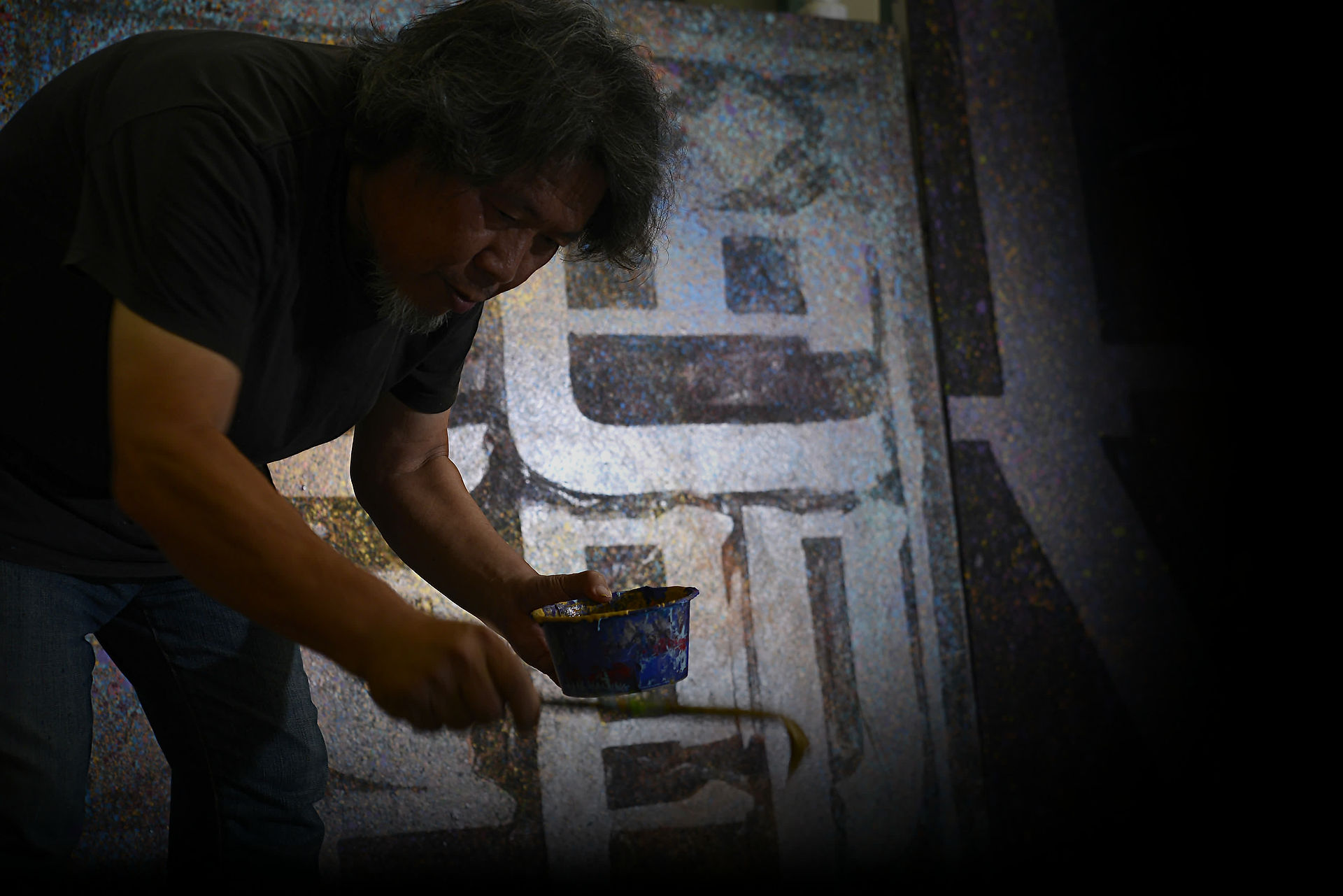
底層的《心經》全文,以密集而重複的方式鋪陳於畫面之中,宛如宇宙中的基本粒子。藝術家以砂粒、飛灑顏料與陰刻般的文字肌理,使經文不再
只是可閱讀的語言,而成為能量振動的痕跡。當觀者靠近時,可以辨識出「色即是空,空即是色」等經句;退遠觀看時,文字又逐漸消融,重新聚合成佛陀莊嚴靜定的形象。
這種由局部到整體、由文字到形象的轉化,正呼應量子力學中的「波粒二象性」—微觀時是粒子,宏觀時又成為波動與整體。藝術家將佛經中的「緣起性空」與量子世界的不確定性互相對照,讓畫面呈現出一種既存在又虛空、既凝聚又流動的狀態。
畫面中央的佛像沉靜端坐,如宇宙中心不動的覺性。金黃色的佛光,從頭部向四周擴散,像能量場一般與背景文字相互滲透。佛像本身並非厚重實體,而是由無數細小色點與微塵構成,彷彿提醒著觀者:所謂形體,其實也是短暫聚合的能量顯現。
作品下方加入蓮花與玄奘西行的意象,更深化了《心經》的精神內涵。蓮花象徵清淨覺悟;玄奘則代表人類對真理與智慧的追尋。他行走於塵世,而佛安住於空性之中,形成「修行」與「覺悟」、「行」與「定」之間的深層對話。
沈昌明長期將佛學、量子力學與當代藝術融合。他認為,《心經》所說的「空」並非虚無,而是一切萬物彼此關聯、流動生成的狀態;而量子世界中的疊加、糾纏與能量振動,也正提供了另一種理解宇宙的方式。因此,這件作品並不只是宗教圖像,而
是一種關於生命本質的視覺哲學。
當觀者凝視畫面時,其實也正在進入自己的內心。那些漂浮的微塵、若隱若現的經文,以及佛像靜默的神情,共同形成一個介於現實與虚空之間的精神場域,使人在觀看之中,重新體會《心經》所說:「照見五蘊皆空,度一切苦厄。」
This work serves as a quintessential example of Shen Chang-ming’s "Quantum Contemporary Art." By utilizing the full text of The Heart Sutra as a structural foundation and layering a portrait of the Buddha upon it, the artist constructs a visual state analogous to quantum superposition. From varying distances and angles of light, the viewer perceives the scriptures and the Buddha image as phenomena that interpenetrate, merge, emerge, and dissolve. Thus, the work is not merely an act of "seeing the Buddha," but a process of witnessing "Emptiness" itself.
The base layer of the full Heart Sutra is densely and repetitively inscribed across the canvas, functioning like the fundamental particles of the universe. Through the use of sand, splattered pigments, and intaglio-like textural depth, the scriptures are transformed from readable language into traces of energetic vibration. Up close, one can decipher phrases such as "Form is emptiness, emptiness is form"; yet, from a distance, these characters dissolve and coalesce into the serene, majestic visage of the Buddha.
This transformation from the local to the holistic—from text to image—mirrors the "wave-particle duality" in quantum mechanics: microscopic particles manifesting as macroscopic waves. The artist juxtaposes the Buddhist concept of "dependent origination and the nature of emptiness" with the inherent uncertainty of the quantum world, resulting in a composition that is simultaneously existent and void, condensed and fluid.
At the center of the canvas, the Buddha sits in stillness, representing the immutable awareness at the heart of the cosmos. Golden light radiates from the Buddha’s form, permeating the background text like a living energy field. The Buddha is not portrayed as a dense, static entity, but as a construct of countless tiny colored dots and motes of dust—a poignant reminder that form is merely a temporary aggregation of energy.
The inclusion of lotus flowers and imagery of Xuanzang’s pilgrimage at the bottom deepens the spiritual resonance of The Heart Sutra. The lotus symbolizes pure enlightenment, while Xuanzang embodies the human quest for truth and wisdom. As Xuanzang traverses the earthly realm while the Buddha dwells in Emptiness, the composition fosters a profound dialogue between "practice" and "enlightenment," between "action" and "stillness."
Shen Chang-ming has long dedicated his practice to synthesizing Buddhism, quantum mechanics, and contemporary art. He posits that the "Emptiness" defined in The Heart Sutra is not nihility, but a state of dynamic flow and interdependent generation. Similarly, the concepts of superposition, entanglement, and energetic vibration in the quantum world provide a new lens through which to understand the universe. Consequently, this work transcends the boundaries of religious iconography, emerging as a visual philosophy regarding the essence of life.
As one gazes into the canvas, one is effectively looking inward. The floating dust, the flickering scriptures, and the silent expression of the Buddha coalesce into a spiritual field suspended between reality and void—inviting the viewer to rediscover the clarity of the Sutra’s promise: "Illuminated the five aggregates as empty, and transcended all suffering.


